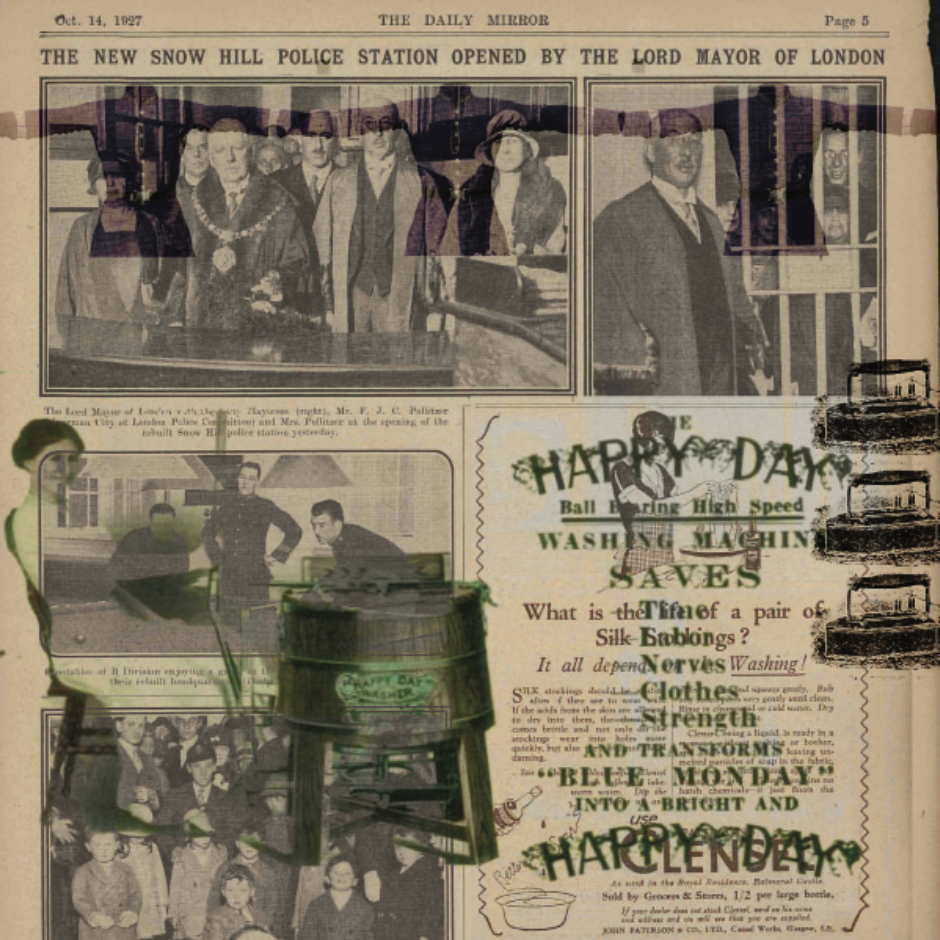
Telling the story of Snow Hill through art
At hub by Premier Inn London Farringdon (Old Bailey), artwork became an important part of connecting the hotel’s contemporary interior with the layered history of the Grade II-listed former Snow Hill Police Station.
The building’s story extends far beyond its use as a police station. Before Snow Hill Police Station was completed in 1926, the site was home to the Saracen’s Head, one of London’s historic coaching inns, while the surrounding Smithfield area has its own long and colourful social history.
Rather than presenting this heritage as a separate exhibition, the artwork strategy was developed to reveal elements of the site’s past as guests move through the hotel.
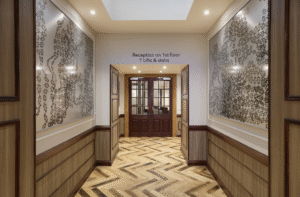
Entrance corridor
Uncovering the story of Snow Hill
Working with Cultural Infrastructure, Whitbread commissioned London-based artists Leily Moghtader Mojdehi and Hilary Yip to create a permanent collection for the historic entrance spaces.
Research into archive material including floor plans, maps, newspaper clippings, police insignia and coaching routes informed 18 layered collages, printed onto metal panels and positioned throughout the entrance sequence.
One of the more unexpected discoveries was the similarity between the historic layouts of the Saracen’s Head and Snow Hill Police Station. In both, public-facing spaces occupied the narrow front of the site, with accommodation, working spaces and courtyards extending behind.
The positioning of the artworks responds to this history, with individual pieces connected to the former uses of the spaces in which they are displayed. The story of Snow Hill is therefore encountered gradually, rather than presented in one place.
Artwork
Extending the narrative
Within the reception, bar and lounge, JSJ Design worked with art consultant Elegant Clutter to develop a complementary collection.
Here, the focus expands from the building itself to the surrounding neighbourhood. Historic photography, mapping and architectural references connect the interiors with nearby Smithfield Market, Holborn Viaduct, St Sepulchre’s Church, Charterhouse and Postman’s Park.
The two collections were developed to sit comfortably alongside one another while retaining their own identities. Together, they give the hotel a sense of place that is specific to Snow Hill and its wider City of London context.
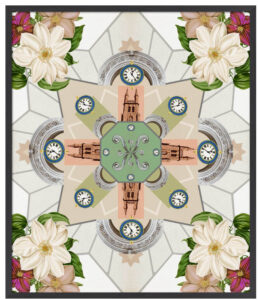
Elegant Clutter Artwork
Returning to Snow Hill
The connection between the building’s past and present took on a more personal dimension during a recent JSJ Design photoshoot with photographer Julian Adams.
Two guests staying at the hotel, Julie and Andrew, had both worked at Snow Hill Police Station as police officers and first met there around 40 years ago. Now retired, they had returned to experience the building in its new life as a hotel.
Their memories brought further context to spaces including the former reading room, offices and original holding cells, which remain intact within the building.
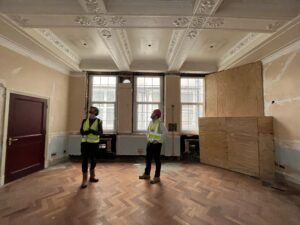
Reading Room during the construction phase
They also recalled traditions associated with policing the Smithfield area. Julie was among the last female officers to wear the traditional police cape and remembered the practice known as ‘mumping’, where officers might occasionally receive small gifts from local businesses. With Smithfield Market nearby, one story involved an officer using the generous folds of his cape to carry an entire leg of lamb home to his family.
These recollections added a human dimension to the archive research that informed the artwork.
For a project centred on preserving and reinterpreting the identity of a historic building, the chance encounter was particularly fitting. Snow Hill Police Station may now serve a completely different purpose, but its history remains visible through its architecture, retained features, artwork and the stories of the people who once worked there.